This morning we said goodbye to our dispersed camping spot near Mammoth Lakes, dumped and filled at Convict Lake, and headed North. We waved to this helpful roadside reminder:
When I was in high school, I would sometimes wear a Bodie T-shirt to school. Apparently, this was so amusing to some that I was voted “most likely to become mayor of Bodie” by my class.
Today, the mayor has returned:
Bodie was a gold rush town in the Eastern Sierras that is maintained in a state of arrested decay, so buildings are not improved but are repaired to prevent them from collapsing. The town reached its peak in the 1880s and was completely abandoned by the 1950s.
Houses were often shingled with flattened out kerosene containers:
There was a rich guy in town:
We peeked in the window of the local gym:
These pumps are “pay inside” only:
The vault is all that remains of this bank:
The gold processing mill sits above the town:
This is the second school in town, as the first one was burned down by one of the students:
The most interesting aspect of the town for me was this structure. Electricity was delivered to here via power lines from a waterwheel attached to a generator, positioned 13 miles away. It was the first time in history that electricity was delivered over a distance via wires. The poles, some of which are still standing, are in a perfect line as engineers of the time were concerned that the electricity would fall off the wire if there was a bend in the line:
The hotel lobby:
We continued North to Reno, Nevada, where we overnighted at the Atlantis Casino. See the trip map for details.
This morning we scheduled dental checkups for the kids in Los Algodones, Mexico. Los Algodones is two miles South of the Q casino where we stayed last night. We drove down to the border, parked in a tribal parking lot on the US side for $12, and walked through the border crossing into Mexico. The signs said No Photography at the border, and I didn’t feel like finding out what the unspoken “or else” might be.
We were very excited to make the trip, as none of us had ever been to Mexico!
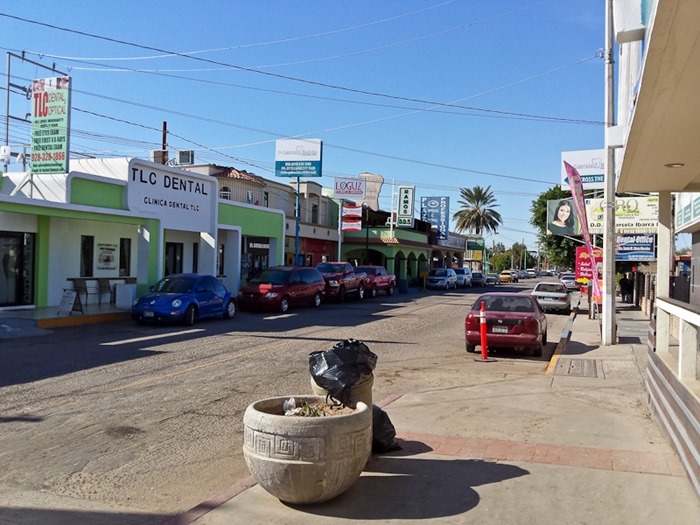
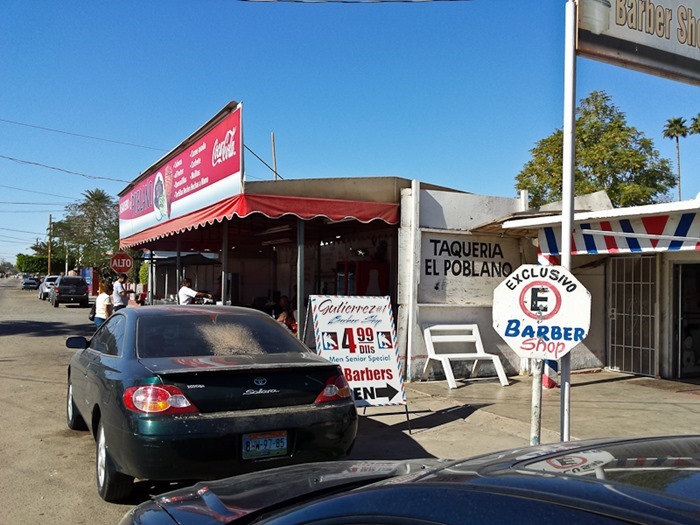
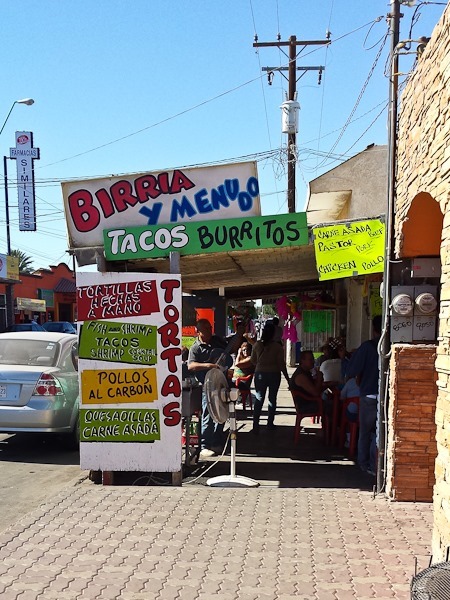
For American visitors, Los Algodones is a two-by-four block enclave of dental and vision clinics, with gift shops and barber shops mixed in for good measure. Trish and I were at least one generation shy of the average tourist age. The town feels perfectly safe, especially when you realize that you’re the most able-bodied target in town.
Our first stop was the dental clinic. We opted for Circle Dental, but there are literally dozens of clinics to choose from. All the other folks in the waiting room were there for dental implants and other serious work. Once the kids finished their cleanings ($30 each), we walked the town a bit:
All the pedestrians are within the passageways over the sidewalks, so it was actually much more crowded than it looks here:
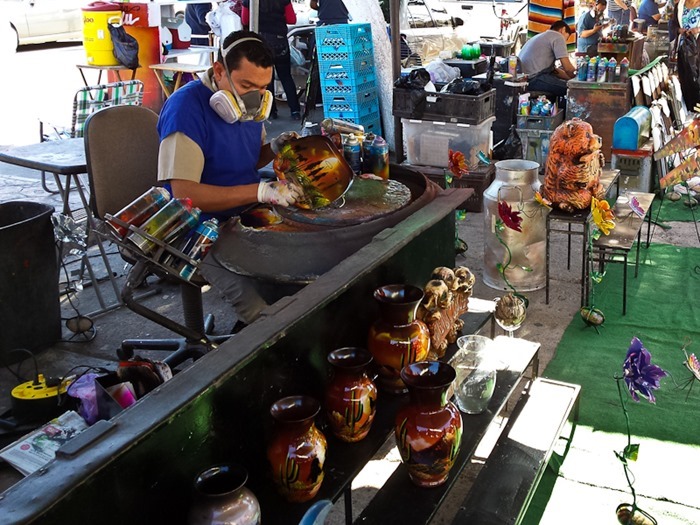
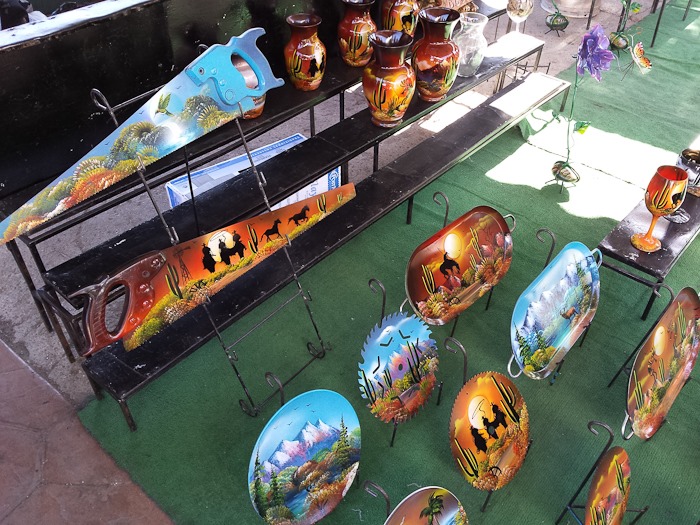
There were hundreds of street vendors running around trying to sell everything from asparagus to wallets. This fellow was painting pots, plates, and saw blades using just spray paint. Bits of torn cardboard were used for masking shapes, and a wadded up plastic bag was used to apply paint with a texture for shrubs and trees. It was very impressive:
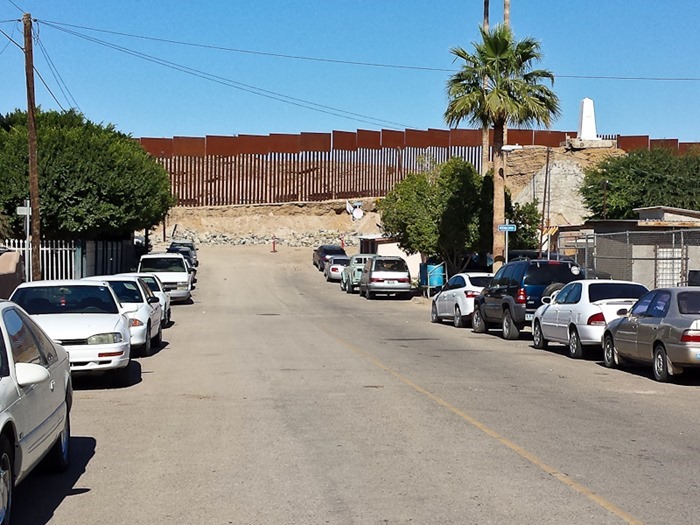
One block North of the shops is the border fence. The obelisk on the right is one of many markers erected in the 1890s to mark the modified US-Mexico border created by the Gadsden Purchase in 1856. Note that the fence was been built well within the US, as the obelisk is on the border:
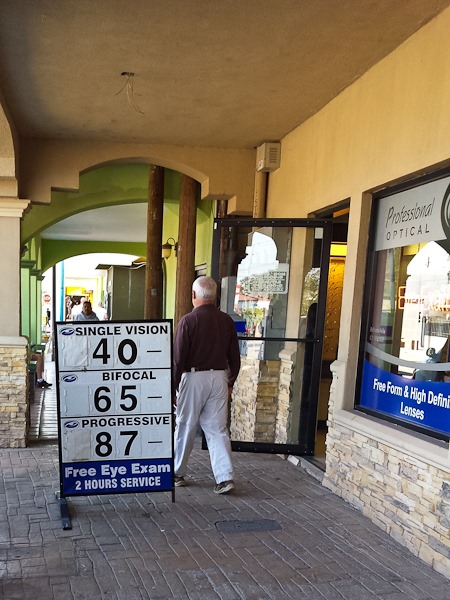
Tricia’s glasses have been scratched up during this trip, so we stopped in one of the vision clinics:
For $70, Trish had an eye exam and ordered a pair of polycarbonate lenses in new frames. We were told to come back in three hours at 4:30PM to pick up her glasses.
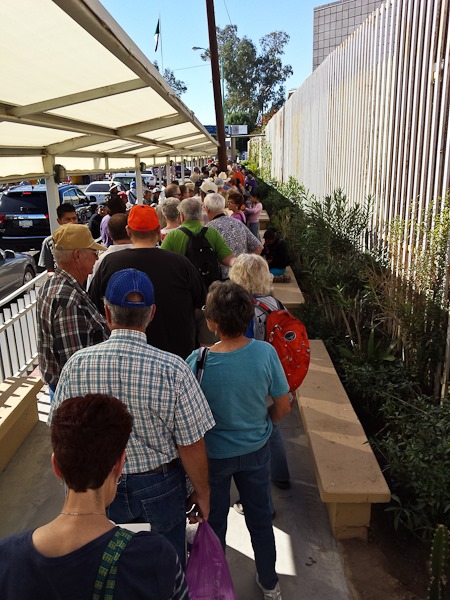
We walked over to the exit line to return to the US. Folks who had been there before told us that it looked like a one hour wait:
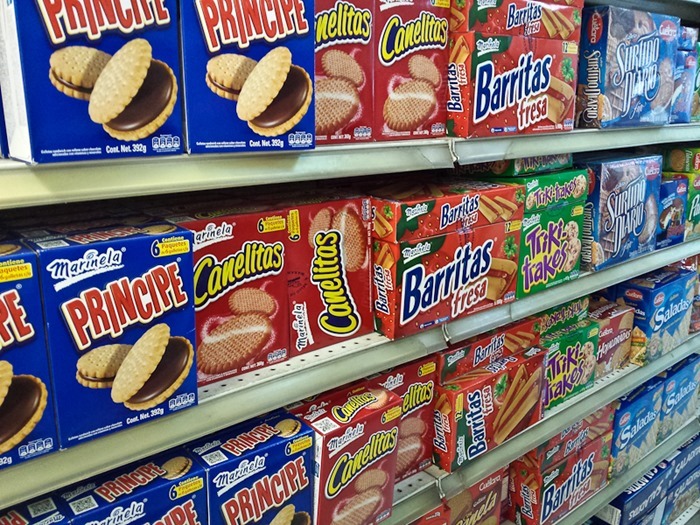
I went back to what seems to be the only food store in town to get some food, but none of the foods are marked as certified Kosher. It’s like we’re in a foreign country:
After clearing customs we headed back to RV and had lunch. We called the vision clinic at 4:30PM and they told us to come back tomorrow at 10AM, so we left the parking lot at the border and headed North.
Throughout the day I had been e-mailing back and forth with Glenn Morrissette, the author of To Simplify, to see if we could meet in person. I’ve been reading Glenn’s blog for a couple years now, and have been following his gutting and refitting of his Vanagon for almost a year. Seeing that we was in Yuma, I sent an e-mail to him, and it turned out that he was overnighting at the Paradise Casino, so rather that return to the Q Casino we headed there instead. The RV lot at the Paradise was quite a bit less crowded:
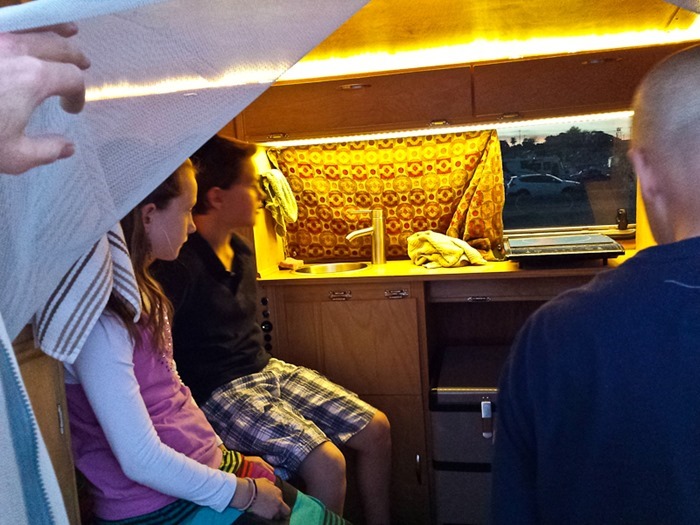
Glenn and I got together around sunset, and he let the kids try out the van interior he crafted from scratch:
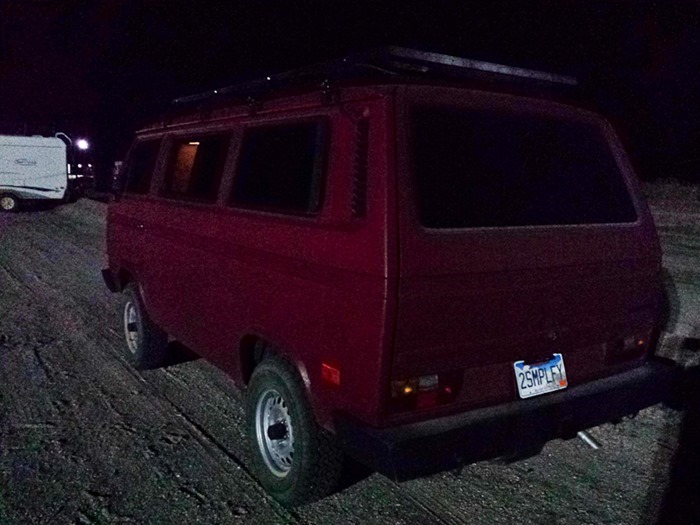
Glenn and I must have chatted for some time, as it was dark when I took this parting photograph:
To explain the blog title “meeting MNFG”, I once mentioned Glenn’s van work to the kids. They asked me if he was my friend, and I said that I had never met him. When they inquired about his doings later, they asked “what is your non-friend Glenn doing now”, so Glenn was thereafter referred to as “My Non-Friend Glenn” (MNFG). Our son pointed out that now that we’ve met, we should just call him Glenn. So be it.
See the trip map for our jaunt South of the border. After picking up Tricia’s glasses, we will head West and North to Palm Springs.
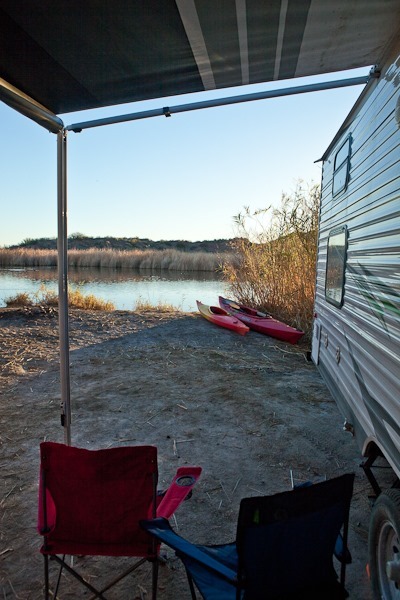
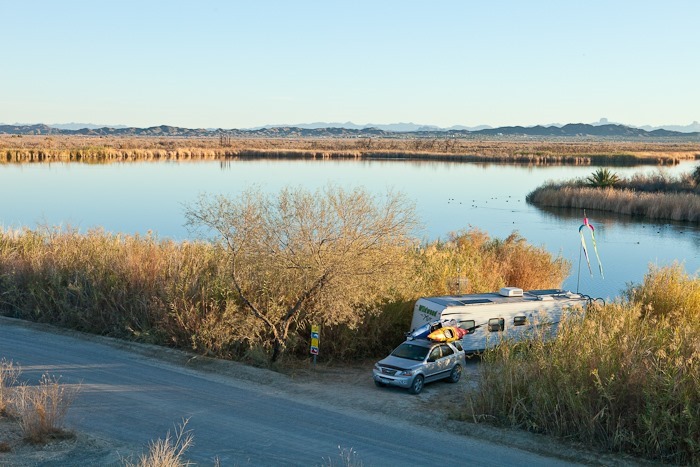
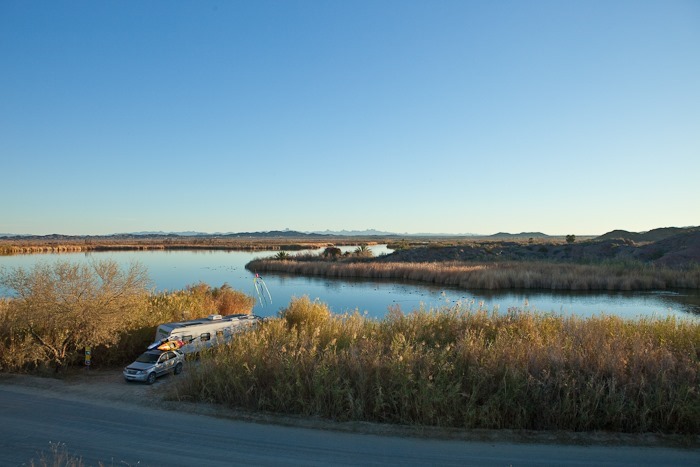
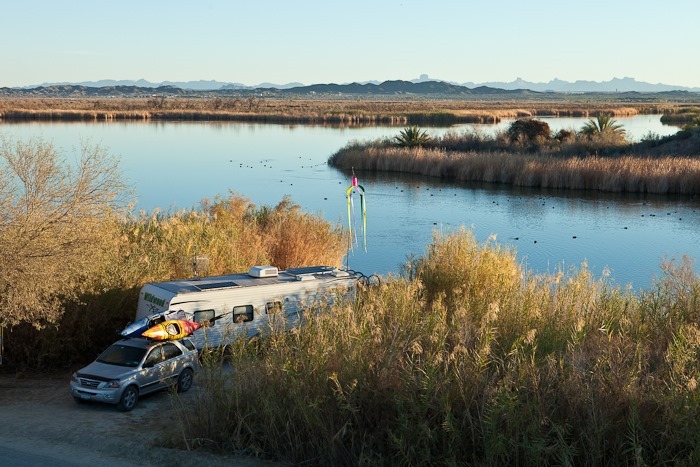
This morning was refreshingly cool after highs in the high 70s on Shabbos. Our front yard at Mittry Lake was as beautiful as ever:
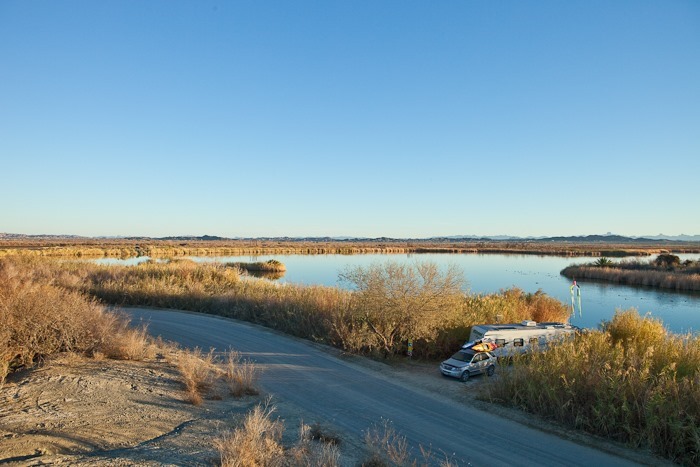
I climbed up the slope across from our site to get a better view:
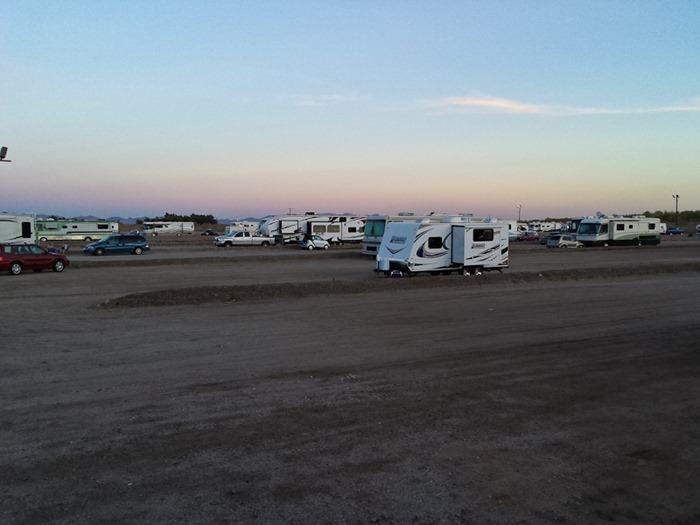
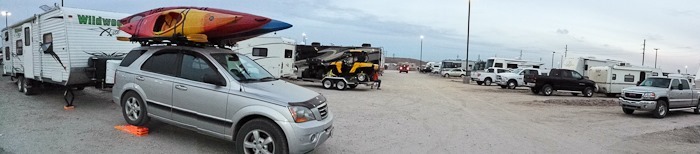
We are in the process of getting to Palm Springs by Tuesday, so we left our site on Mittry Lake and headed into Yuma. We did our dump-fill-shower-dump-fill at a local RV park, then headed into town where Trish did the food shopping while I did the laundry. We stopped at a local park for a late lunch / early dinner, then headed a few miles West, crossing into California and stopping at the Quechan Casino for overnight parking. We expected to find a half dozen or so rigs next to us, as we did when we were casino camping in Northern California, so imagine our surprise when we found hundreds of rigs in the lot! This is a photo of one of several rows in one of several parking areas:
Tomorrow we will continue West. For today’s drive, see the trip map.
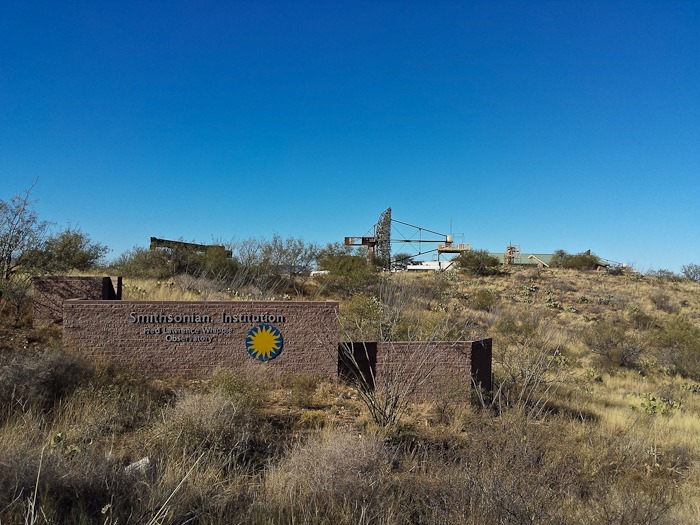
This morning, we left the RV where it was and walked the half mile or so up to the Whipple Observatory visitor center:
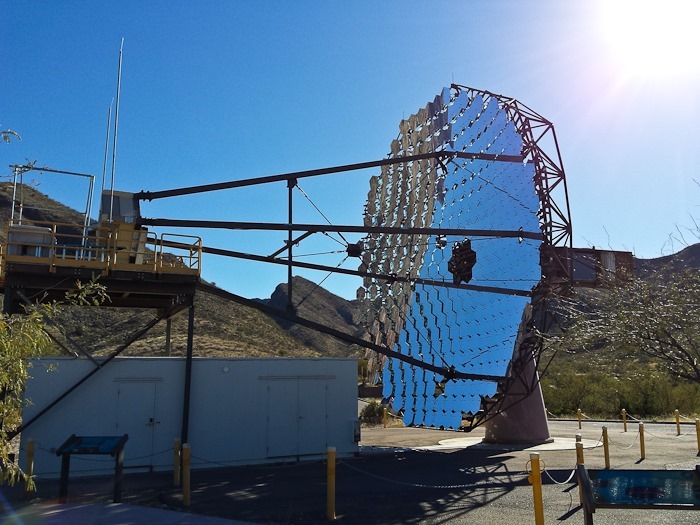
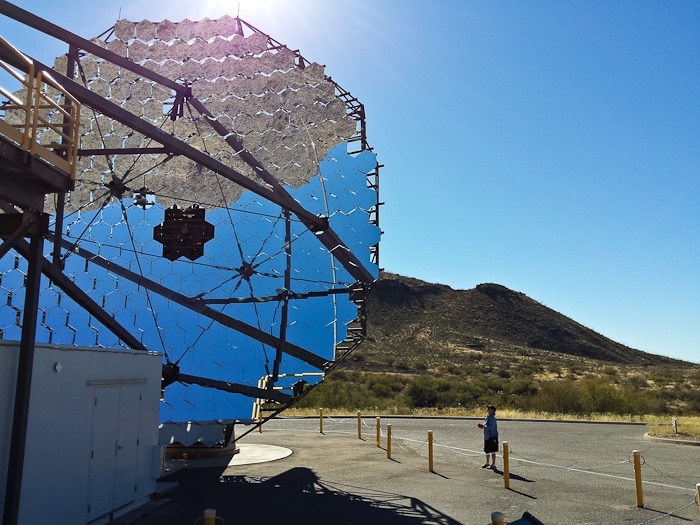
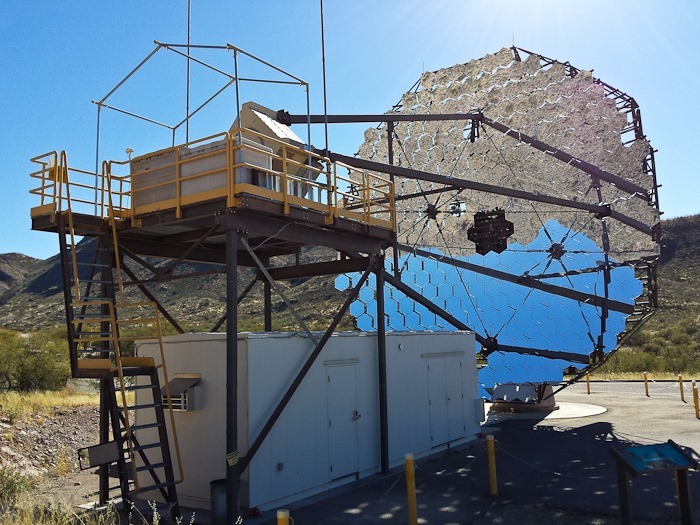
The visitor center is 12 miles and 4,500 vertical feet below the observatory itself, which sits atop the craggy summit of Mount Hopkins. The primary instruments located at the visitor center are the VERITAS gamma ray telescopes. Each of the four telescopes in 30 feet in diameter:
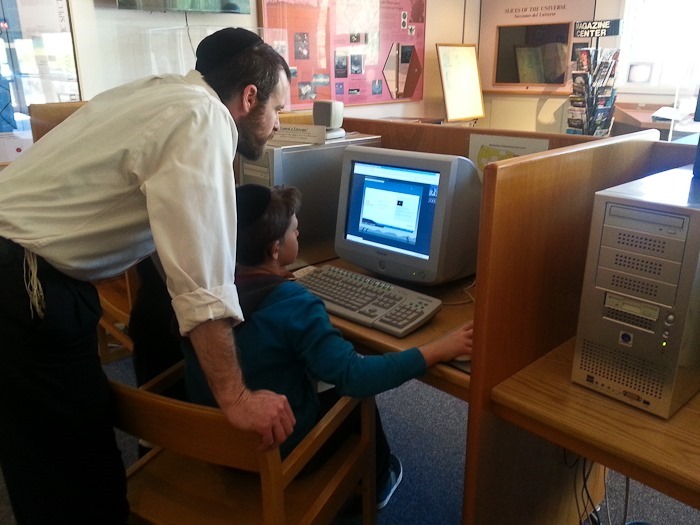
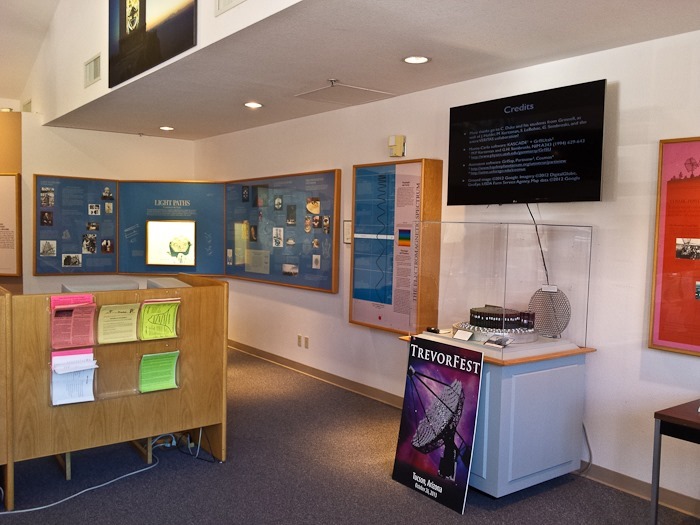
In the visitor center, stations are set up to schedule an astro-photograph to be taken from the on-site automated telescopes. Assuming there are clear skies tonight, we should receive our image of the Ring Nebula (M57) tomorrow:
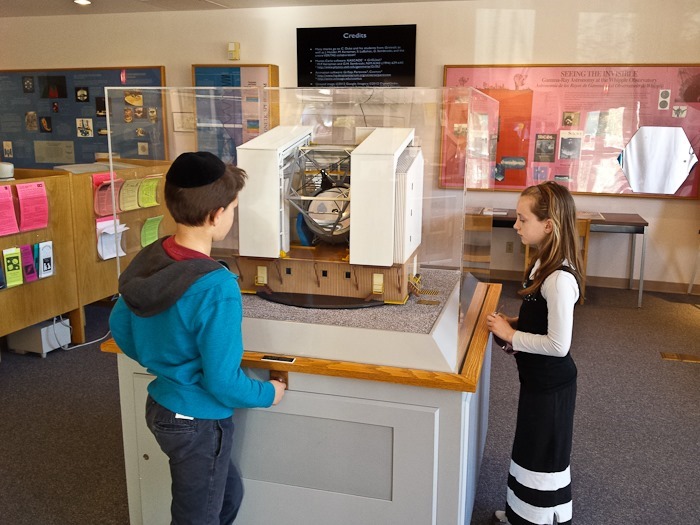
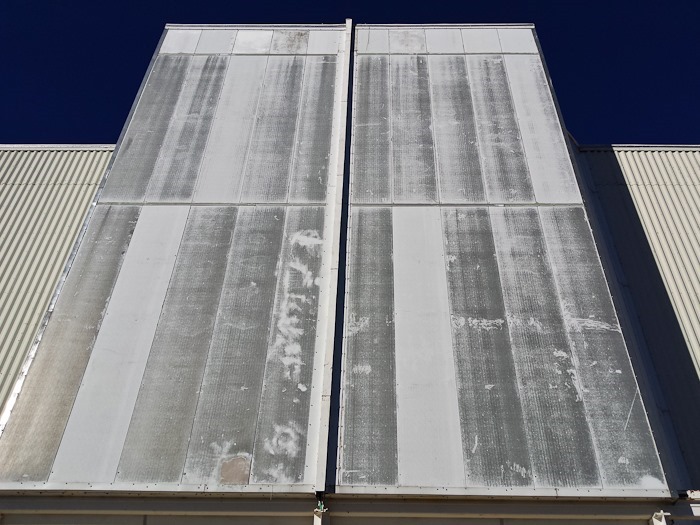
The visitor center had a model of the MMT, which sits at the top of Mount Hopkins. Initially a telescope with six 1.8 meter mirrors, the MMT was refitted with a 6.5 meter mirror thanks to a new mirror spin-fabrication technique that now allows mirror greater than 5 meters in diameter to be made in a practical weight. The MMT houses the third-largest optical mirror in the world. To keep the size of its building practical, the entire building rotates, allowing the telescope to only have to rotate up and down within the building:
Trish ponders one member of the VERITAS array:
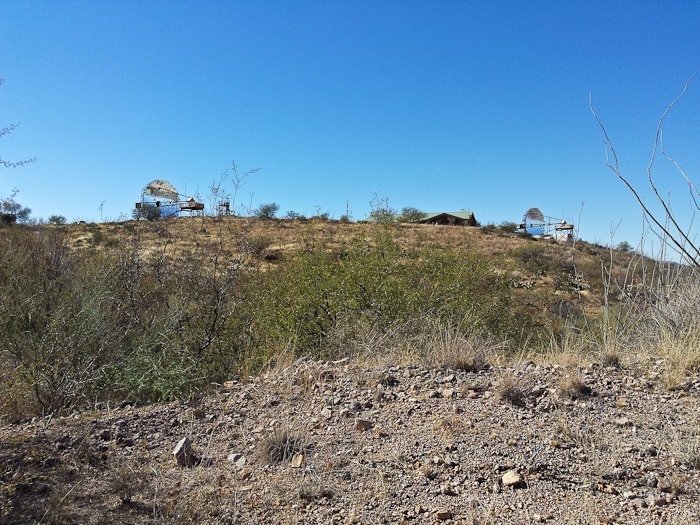
As we walked back to the RV, we could see two of the VERITAS telescopes:
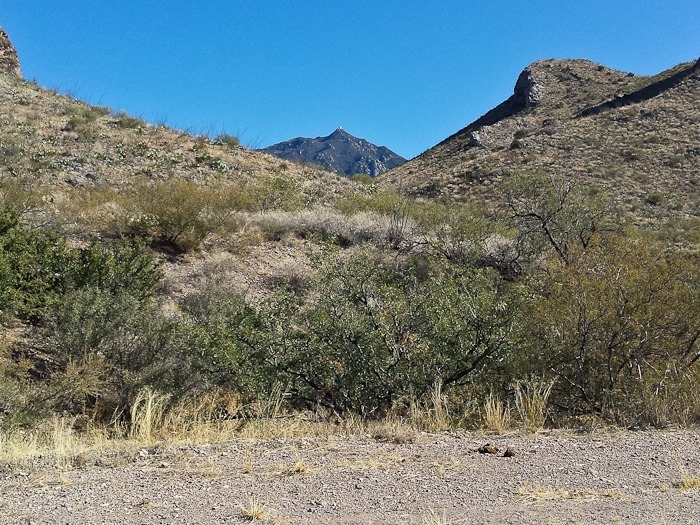
In the distance, we could make out the MMT on Mount Hopkins:
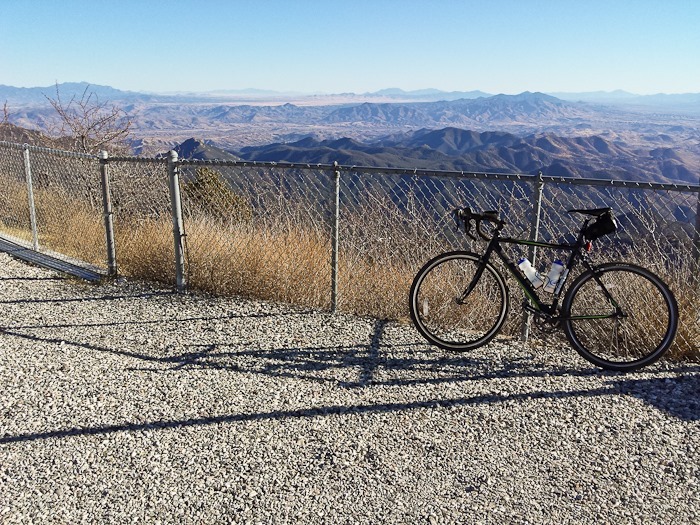
Unfortunately, the only to see the MMT up close is by tour bus, as vehicle traffic is restricted about 2 miles from the summit. Because the summit is at 8500 feet, ice is a frequent problem on the road, so the tour bus only operates from March through the fall. The docent did say that the road is open to bikes, so I decided to attempt the ride. It’s a 12.2 mile road, mostly gravel, to the top, with 4500 feet of vertical climbing. This climb, on pavement, is a UCI Climb Category 1 climb, and is only 500 feet of climbing shy of being rates Hors Catégorie, the highest rating for a climb in road cycling.
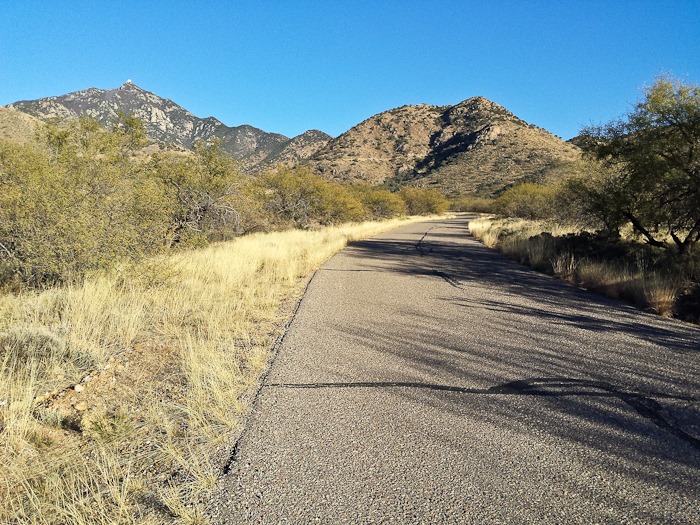
The first couple miles of the route are paved:
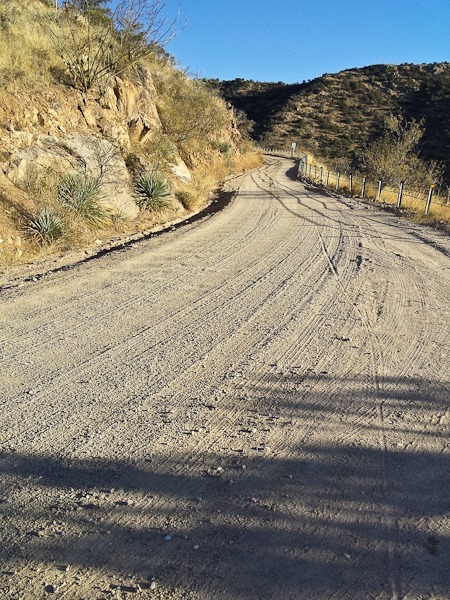
The road quickly gets steep and goes to gravel:
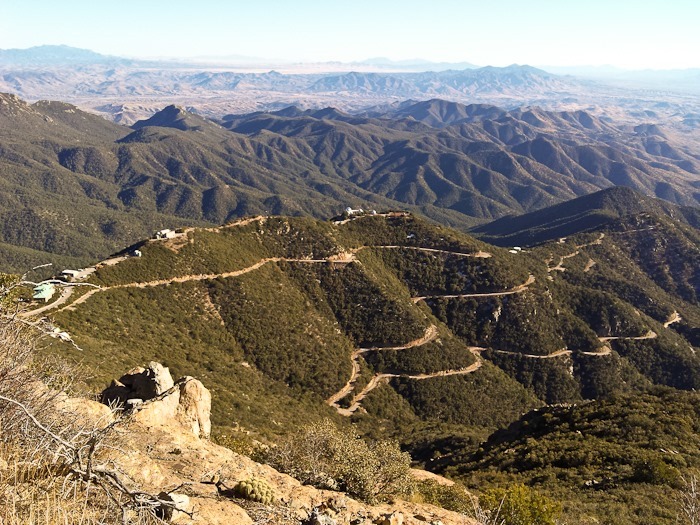
At 6000 feet, I started to encounter snow on the shoulder and bits of ice on the road. With 5 miles to go, there’s still a lot of up left. Note the switchback below:
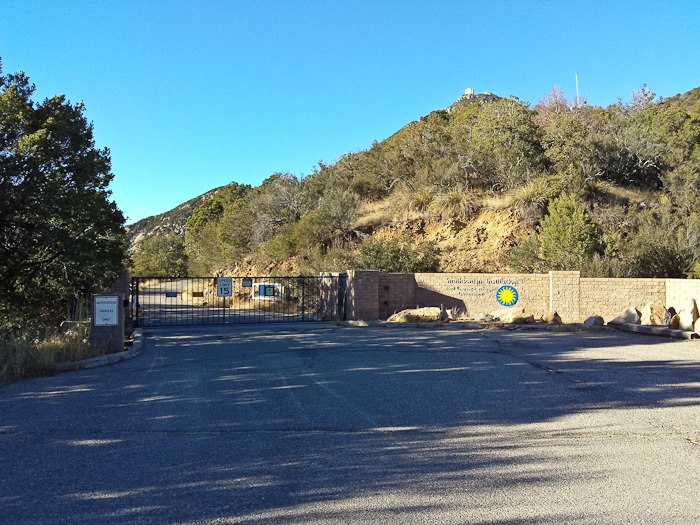
After 10 grueling miles of constant climbing, the road goes back to being paved and there’s a gate to be walked around:
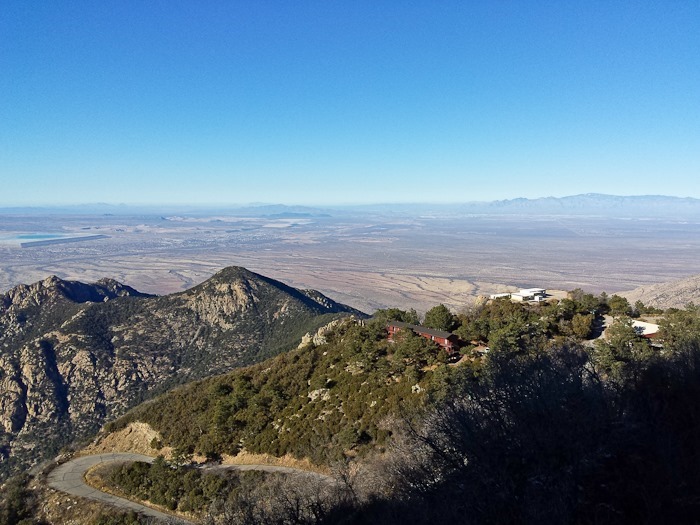
The summit is at 8500 feet, so breathing became even more difficult in the final stretch. The last 200 yards ratchet the grade up to over 20%! At the summit, the cycle computer reported 12.2 miles ridden in 1 hour, 57 minutes, with 4634′ or vertical climbing. Once at the top, I could look down on the dorm facilities for the researchers:
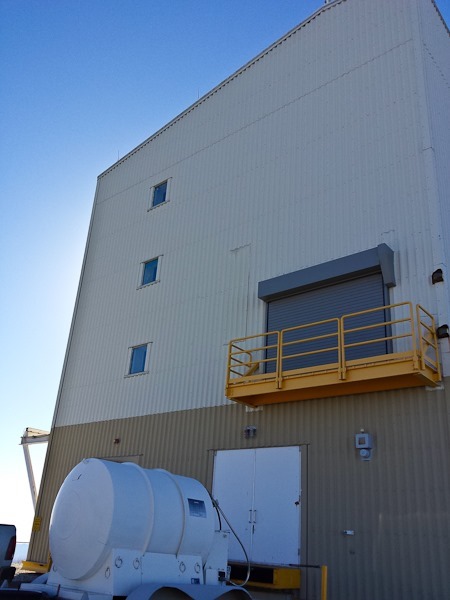
The top of the mountain is so small that I couldn’t get far enough away to take a photograph of the whole MMT building:
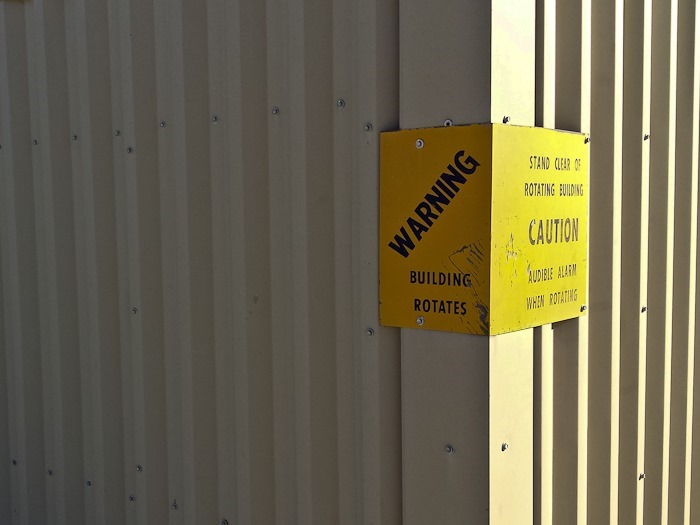
It’s disconcerting that the sign is scratched. I wonder what they hit…
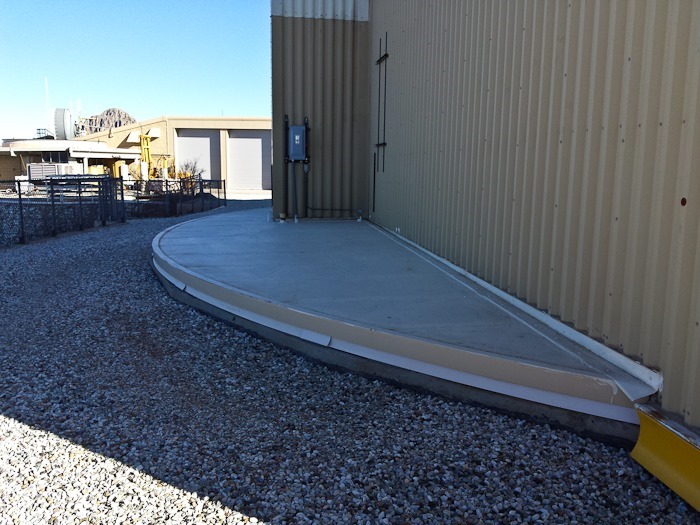
At ground level, the building’s base rotates over the pad underneath:
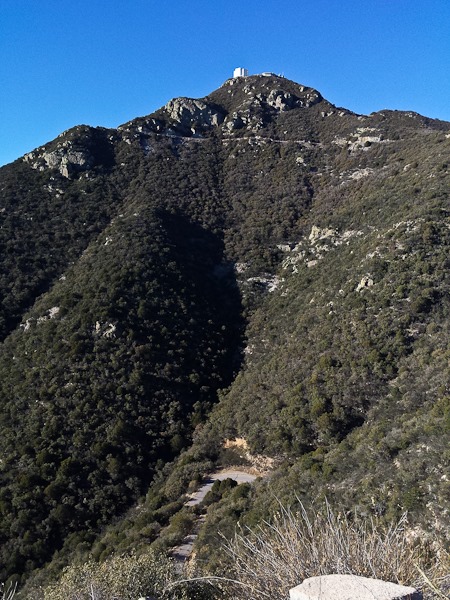
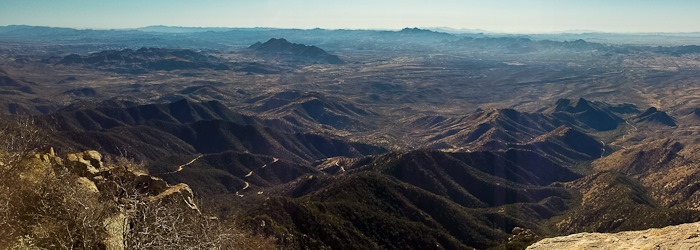
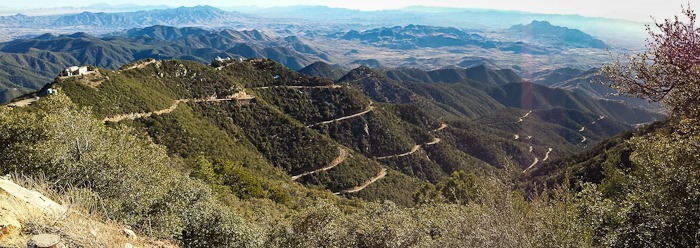
The ribbon of road up to the summit can be seen starting on the right edge of the photo:
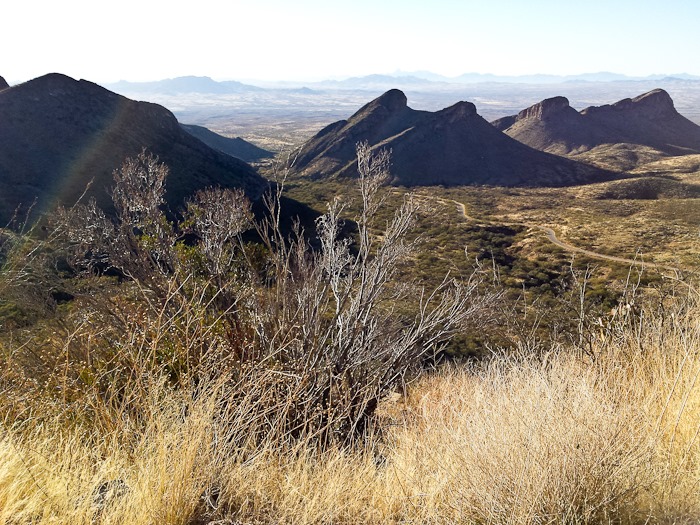
More of the crazy climb to the summit. The 1.5, 1.3, and 1.2 meter reflector buildings can be seen in the center of the photo:
The doors of the MMT building:
Another view of the last few miles of the climb:
The first 100 yards of descent from the MMT building are so steep that I walked the bike down lest a hardware failure lead to an uncontrolled vault over the railing to the rocks far below. After that, I did my best to keep both speed and rim temperature under control. It took about 45 minutes to get down.
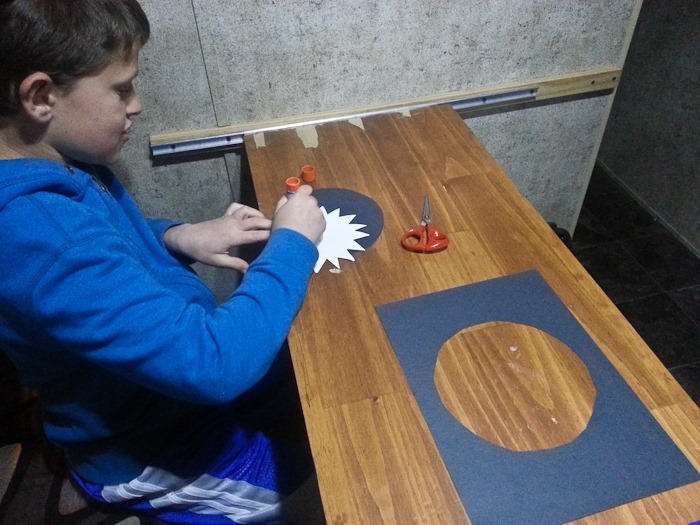
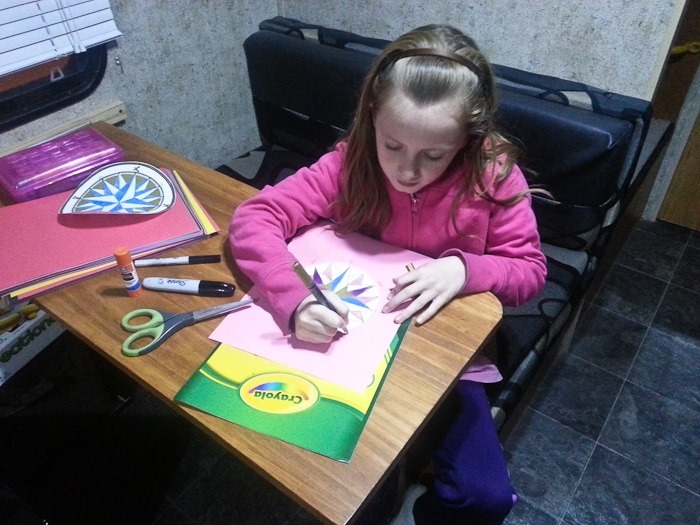
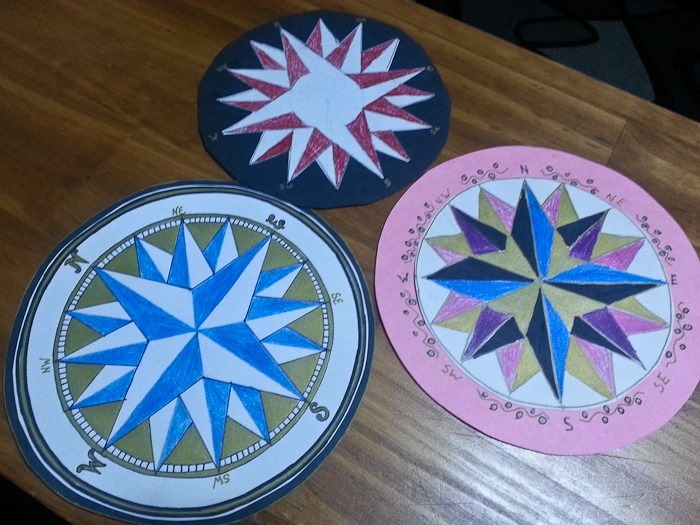
Back at the RV, the kids were completing a geography unit making their own compass roses:
After showers, we headed out at dusk about 40 miles North to overnight once again at the Desert Diamond Casino. See the trip map for details.
We left the Walmart in Tempe, AZ this morning, and after stops at Lowe’s and the bank, we headed Southeast to Casa Grande National Monument. There’s not much here, as the Monument exists primary to preserve and interpret the three-story “Casa Grande”, the largest known structure built by local 15th century Native Americans:
It doesn’t seem like much of an accomplishment, but considering the fact that the entire structure was built using clay plastered over wood framing, it’s pretty impressive:
Junior Ranger badges were earned, as usual:
Leaving Casa Grande, we headed South towards Tucson, stopping at a Walmart for dinner. This Walmart has “no overnight RV” signs posted, probably due to local campgrounds lobbying town government to restrict overnight camping in an attempt to force RVers to pay for camping at their facilities. I suspect most RVers in fact do what we did, namely, move on to the next free parking location. The real loser here is Walmart, as RVers that park overnight tend to purchase items while they’re there.
We headed South for another 20 miles and are parked for the night at the Desert Diamond Casino on South Nogales Highway. There are 10 or so other RVs here, and we do have WiFi, though it’s only twice the speed of dialup. Tomorrow we will head East to Chiricahua National Monument. See the trip map for details.





 Facebook
 Instagram
 Email
Email