Day 118: Modifying the generator to run on propane

Today’s highlight was installing a tri-fuel kit for the generator that I had purchased before we left home. By converting a generator to run on propane as well as gasoline, we will be able to run the generator much longer since the RV has 10 gallons worth of propane on board, whereas the generator’s built-in tank only holds a little over a gallon of gasoline.

Another advantage is that once we get home, I can bring out a natural gas connector and plug it into the generator so that during a power failure we don’t have to keep filling the generator.

The tri-fuel kit works by installing a fitting between the air filter and the air intake on the carburetor. A hose runs from this fitting to the propane carburetor which is installed on the outside of the generator. The propane carburetor regulates the amount of propane that is mixed with air and injected directly into the gas carburetor.

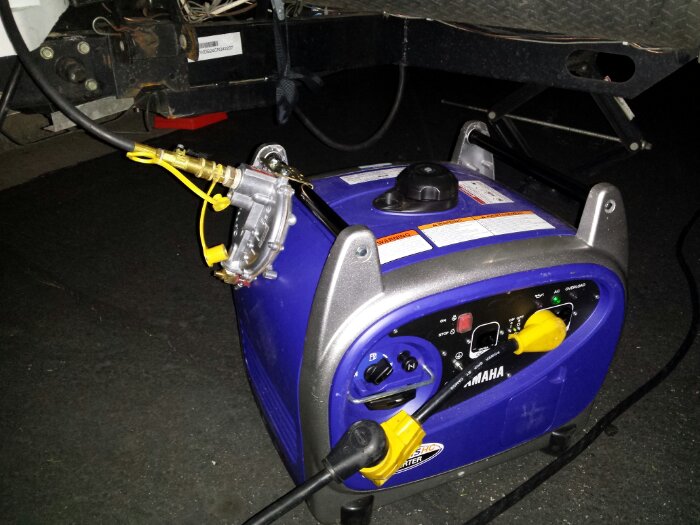
Here’s a photo of the generator after I’ve installed the kit. It’s using a quick release to the RV’s propane tanks. The circular object on the outside of the generator is the propane carburetor. The red hose at the bottom of the propane carburetor is how the propane gets into the gasoline carburetor in the generator. I had to drill a hole through the case to route the hose:
image

Day 112: Generator fixes and familly time

Days have a way of slipping by here in Las Vegas as we spend time with my parents and attend to a number of little fixes and modifications that we’ve been saving for when we have a real garage to work out of. A few things also had to wait as I needed parts which I had shipped to my parent’s house. Amazon Prime is great with free two-day shipping, but it seems packages can’t be addressed to “BLM land outside of Joshua Tree National Park”.

Last night, we left our great curbside parking next to one of the community’s Rabbis and drove the RV to my parent’s house. Their HOA only allows one 72 hour stay per month, so we’re here until Friday afternoon, at which point we will go back to the Rabbi’s house.

This morning, on the way home from synagogue, we passed a group of cyclists on a group ride.  They shouted their website to me as I was driving, so I went home, loaded the que sheet into my phone, changed into my cycling gear and hit the road.  I was about 30 minutes behind them, and after 26 miles I had reduced the gap to 15 minutes at the finish.  Here’s the route:


One of the issues we’ve had for weeks is that the generator only runs when the choke is partially choked. I was pretty sure that the issue was with one of the jets being clogged in the carburetor, but the jet’s hole is smaller than the diameter of a staple leg, so I had to order a set of very small drill bits to attempt the cleaning.

Here’s the jet on the container of mini drill bits. Something is clearly stuck in the jet:

image

After clearing the debris by gently augering the hole with a dril bit, the jet is ready to be reinstalled:

image

My brother and I started up the generator and it now runs flawlessly!

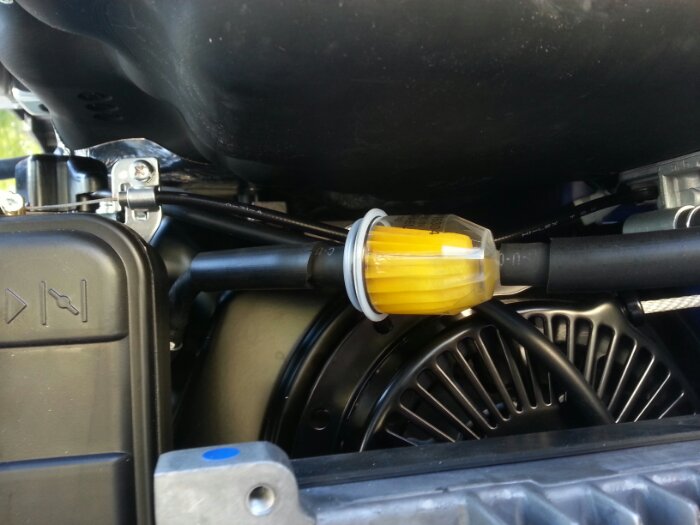
As long as we had the generator open, I installed an inline fuel filter I’ve been carrying since we left New York so that future fuel contaminants are trapped by the filter and don’t clog the jet again:

image

Meanwhile, Trish was making a feast of a dinner with Mom and my brother’s girlfriend:

image

Another productive and yummy day in Las Vegas!

Buttoning up the RV

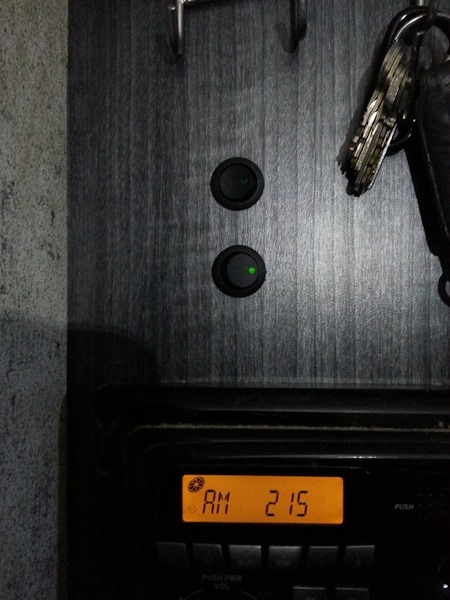
While Trish was shopping at Walmart, I was out in the parking lot with a drill and soldering iron.  Until now, turning the cellular amplifier and wireless router on and off has involved plugging in or removing 12V cigarette lighter-style cables to and from a 12V socket.  I installed two switches with indicator lights to turn these on and off:

20131008_021451

And yes, the time on the stereo is unfortunately correct.

Tidying up the electronics

I had a spare moment one morning this past week, so I turned a mass of wires and boxes laying on the bottom of the cabinet into a wall-mounted model of efficiency.  Pictured here are the back of the stereo, our WAP, the PoE adapter for the WiFi antenna, and the booster for our cell antenna.

image

You raise me up…

We’ve been having a problem with the back end of the RV hitting the ground when we drive into a steep driveway.  The problem was so bad that I welded a set of skid wheels onto the back of the RV.  Last time they hit, we were going around a corner, and while the wheels held up, the sideways force bent the frame member to which one of the wheels is attached.

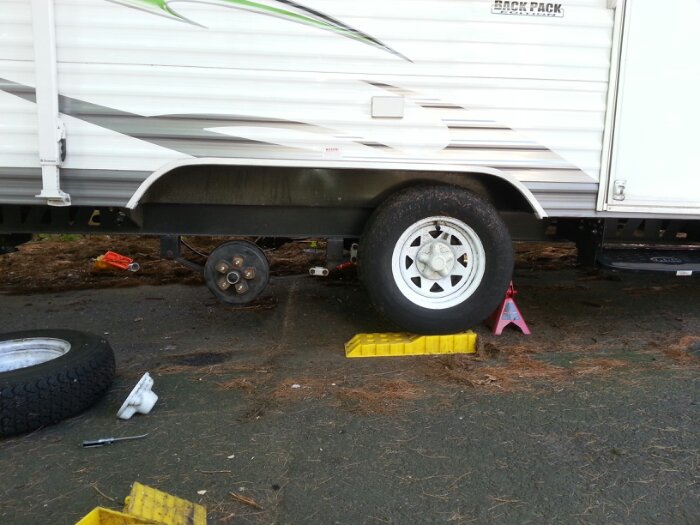
I decided more drastic action was in order, namely removing the axles from being mounted above the leaf springs and mounting then below the leaf springs.  This move would increase the trailer clearance by about 5.5 inches, which should be enough to eliminate any bottoming out issues on steep driveways.

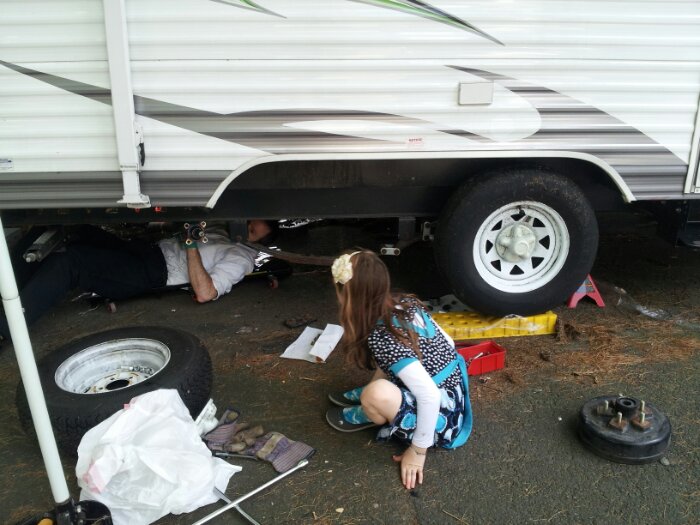
The first step was to remove the axle:

image

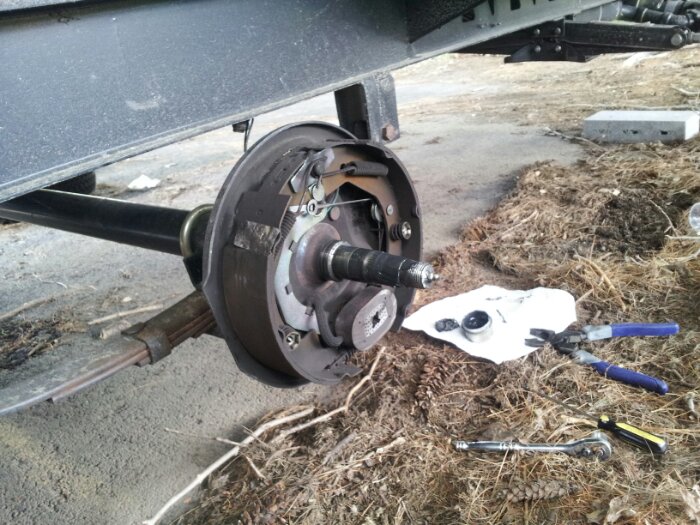
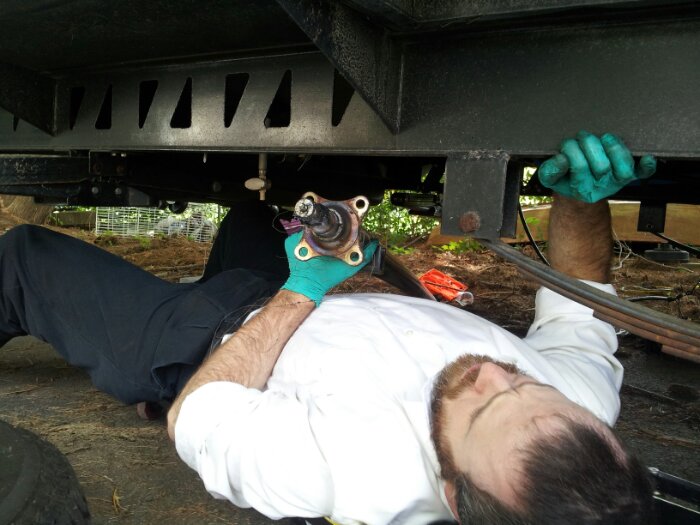
Next I removed the hub:

image

image

Next, the brake plate comes off:

image

Finally, the axle is removed:

image

image

image

The axle has some bend in it so that it is flat when under load.  Therefore the axle has to stay in the same orientation as before.  This means that the axle perch, the component that meshes the axle to the springs, is facing the wrong way, as the axle used to mesh to the springs on the axle’s bottom.  Now that the axle is below the springs, the axle perch needs to be on top of the axle.  This problem is solved by adding a second axel perch.

Here’s the difference for between the modified axle (left), and the original axle (rght):

image

I did all four axles.  Now that it’s done, I hope we will never have to deal with the back-end of the trailer dragging along the ground.